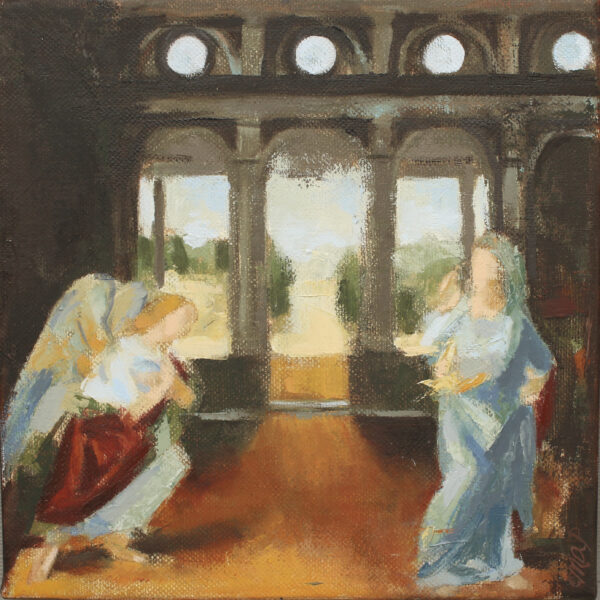
Annunciation after Lorenzo di Credi, Oil on Canvas 8″ x 8″ ©Michelle Arnold Paine All Rights Reserved. Click to Purchase
Annunciation Studio Exercise
For more than a decade I have been making “transcriptions” of classic Annunciation paintings as an ongoing studio project. The Annunciation has been one of my favorite images for many years. Found in the Gospel of Luke, the scene tells the story of how Jesus comes to be born of the Virgin Mary. The Angel Gabriel comes to Mary and tells her she is “highly-favoured” and that she will bear a son. Gabriel’s words become the first part of the “Hail Mary” which Catholics still pray today: “Hail Mary, full of grace, the Lord is with you. Blessed are you among women and blessed is the fruit of your womb, Jesus” (Luke 1: 28). Mary reminds the angel that she is a virgin, but she accepts the task she has been given, saying “May it be to me according to your Word” (Luke 1: 38).
Art Links the Past and the Present
“Great art of the past did not appear out of a vacuum; it had a continuous link with its precursors, distant and recent. It reached for the life line of understanding the past holds out to the present.” – Graham Nickson
Artists have always studied the great art of the past. When I spend time in front of a work at a gallery or museum, I feel something of this past reaching out to the present. For me the practice of copying (or “transcribing,” in Graham Nickson’s words) Medieval and Renaissance Annunciation paintings is also a form of contemplation.
What is A Transcription?
Sketching from masterworks had been a part of my art education at Gordon College and it’s arts-focussed study abroad program in Orvieto. However, participating in a New York Studio School Drawing Marathon plunged me deeper into the practice on a greatly amplified scale. Painter and NYSS Dean Graham Nickson introduced me to the term transcribing, in which we seek to investigate “the power of the work through its construction rather than emulating its look or style” (Graham Nickson).
In other contexts, a “transcription” refers to an arrangement of music for a different instrument than the one for which the piece of music was originally written. To transcribe can also mean to put spoken words into writing. In both cases, the content of the original work remains, but it has been interpreted, adapted. Within the context of visual arts, a shift from large scale to small, or from painting to drawing, creates a work that is simultaneously old and new. Pieces of the original are lost while gaining new insights and forms in a new medium.

Transcribing Signorelli
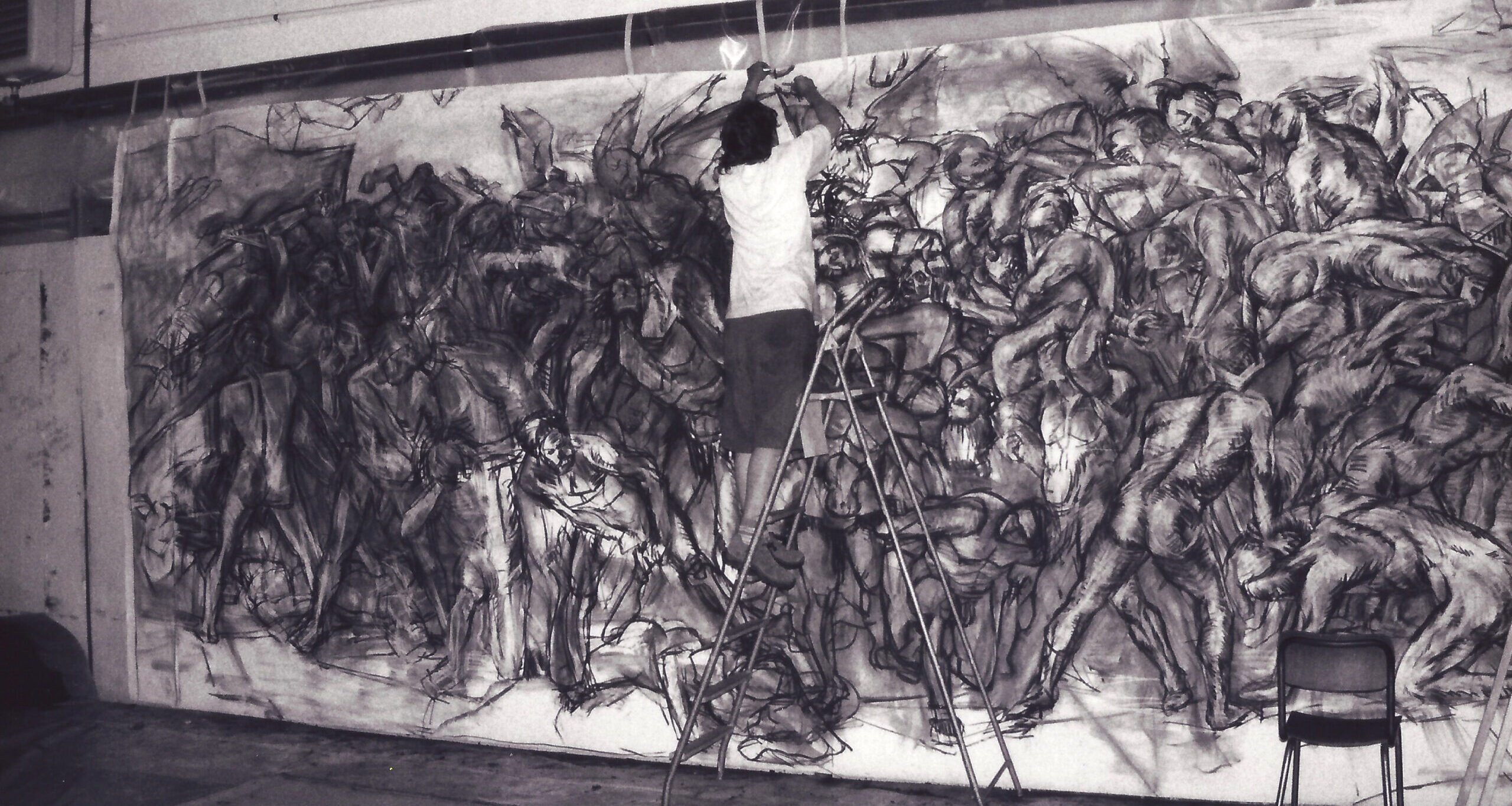
Most of the students on this two week summer Drawing Marathon were full-time NYSS students from New York. It was a study trip in Orvieto, Italy, where I was living, so while the other students stayed in hotels or apartments, I was able to commute from my home in Orvieto. Except for a couple of field trip days, we drew 8 hours a day, every day. The second week of the session the entire group concentrated our efforts on a to-scale, life-sized transcription of Luca Signorelli’s fresco from the Orvieto Duomo “The Damned in Hell”.
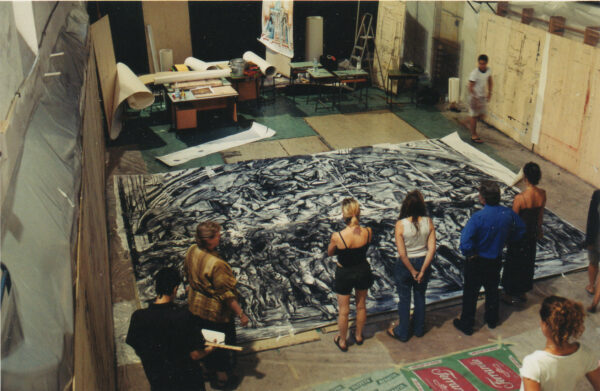
This experience of collaborating on a work of this scale was profound and humbling. I was in awe of the teaching assistant who somehow figured out how to accurately scale the drawing from our color photocopy reproduction (though we visited the actual fresco almost every morning in the Cathedral). We began by working on our individual, three foot wide segments, but after a day or so the work drew us in and all of us moved across the entire wall, obliterating marks the others had made, making corrections, bringing out lights with our erasers, and confronting each other if we believed that a figure needed to be moved. There was no room for ego: every mark was in service to the power of Luca Signorelli’s original work.
We ended each day covered in charcoal.
We brought to the process our historical context, as well as the visual language of our time and our individually unique mode of using our tools. I cannot recreate what Luca Signorelli or any other artist created, but I can wrestle with it. The drawing was a vehicle for deep engagement with the work of art.
A transcription is an adventure, an entry into the unknown in search of knowing. It is a fount of possibilities never before fully realized that will nourish the transcriber when that person returns to his or her own work. – Graham Nickson
Transcribing “The Damned in Hell” from fresco to charcoal changed the process, as charcoal is much more flexible and forgiving a medium. Though we sought to maintain the composition and content of Luca Signorelli’s original narrative, the final appearance of the final product is different: the refined smoothness of Renaissance forms has been transcribed into the expressionist and process-oriented mark-making of the late 20th/early 21st century.
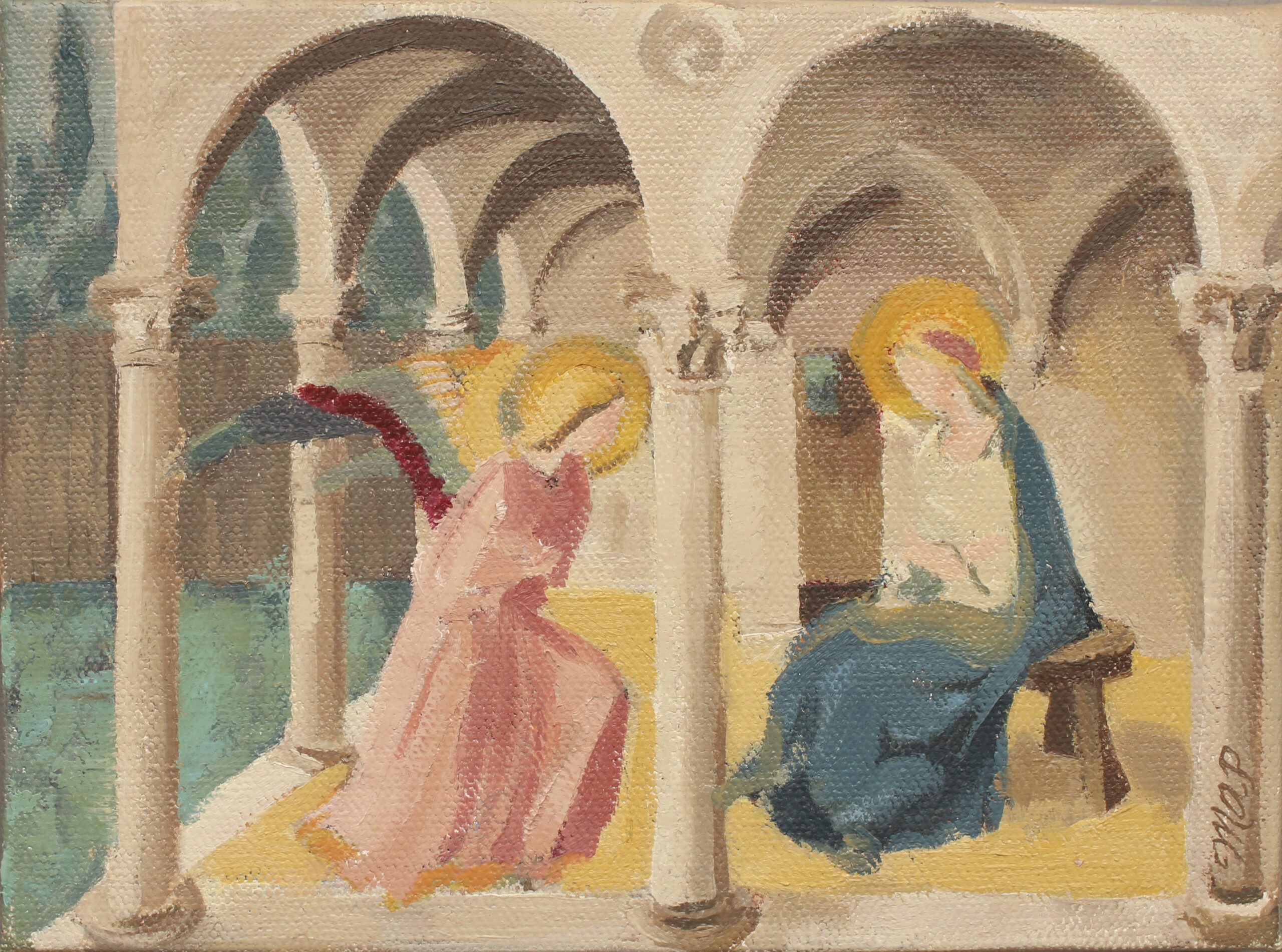
San Marco Annunciation Transcriptions
On a smaller (much smaller!) scale I have maintained this practice of transcribing as I seek to represent Mary in a way that is accessible to myself and others here in the 21st century.
This first painting in the series was a study of a fresco by Fra Angelico located at the top of the stairs of the Monastery San Marco in Florence, Italy. I have now circled around and created a second version of that first small painting (new version pictured above). The monks would have viewed this every time they ascended or descended the stairs to and from their dormitory area. There is a serenity and a contemplative quality in the color palette and the composition which is compelling to me.
For me, this process of responding to artworks of the past is a process of listening. I wrote previously on the blog about creating transcriptions of the Annunciation while participating in a project during the Catholic Church’s Synod on Synodality. Just as communities need to spend time listening before making decisions about future direction, I need to “listen” to the art of the past as part of my creative process.