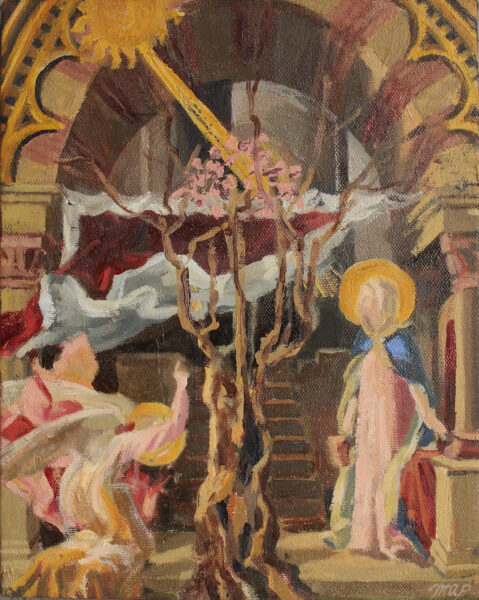
Annunciation after de Chiti, Oil on Canvas 10″ x 8″ ©Michelle Arnold Paine 2025 Private Collection
“Transcribing the past”
Last spring I accompanied a group of Anglican pilgrims to Italy during Holy Week. Upon my return I began several new Annunciation “transcriptions”. These are paintings which I make as studies of historical paintings. The intent is to study and meditate on the Annunciation by engaging with previous representations of this narrative. The studies build a foundation for painting my own experience and interpretation of Gabriel’s announcement to Mary in Luke 1. For this round I wanted to “transcribe” some of the Annunciaton paintings we had encountered in person.
One of the most personally impactful artworks I encountered on this trip to Italy was an Annunciation painting in St. Mark’s English Church in Florence, Italy. Since we were traveling during Holy Week, the English-speaking group I was accompanying attended Holy Thursday service there.
Annunciation with Staircase
St. Mark’s English church had beautiful vaulting, though it was small and cold. I am always on the look out for Annunciations because of my series of Mary paintings which is in continual development. As I was taking in the environment, a painting hanging on one of the columns caught my eye. In this unique Annunciation painting there was not only a dried tree stump, front and center, but also a stairway in the background. In addition to the stairway there was also a curtain blowing in the wind.
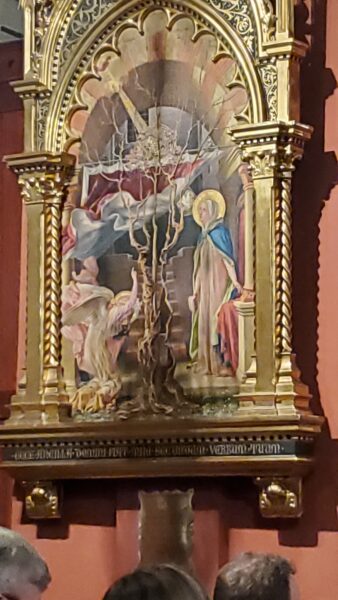
Annunciation, by Giuseppe Catani Chiti of Prato (b. 1866) in St. Mark’s English Church, Florence, Italy
The Root of Jesse
I have used the elements of both a dried tree stump and stairs in my own representations of the Annunciation. One well-known prophecy of Christ is the “Root of Jesse” from Isaiah 11:1 “A shoot shall spring forth from the stump of Jesse.” In Ezekiel 17:24 there is a similar prophecy: “I have made the dry tree to flourish” . The imagery of a dead branch appears often in my paintings. The contrast between dead and flourishing is visually powerful, as pictured here in my two paintings:
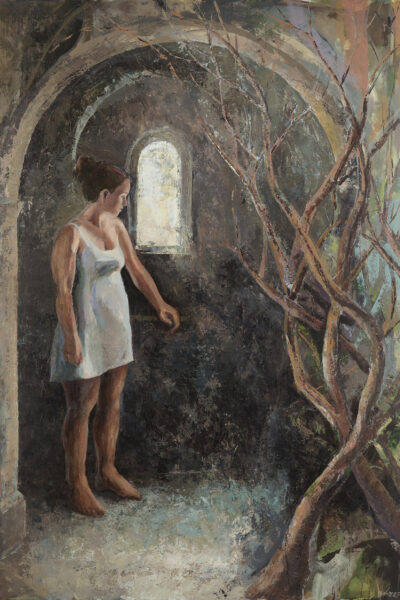
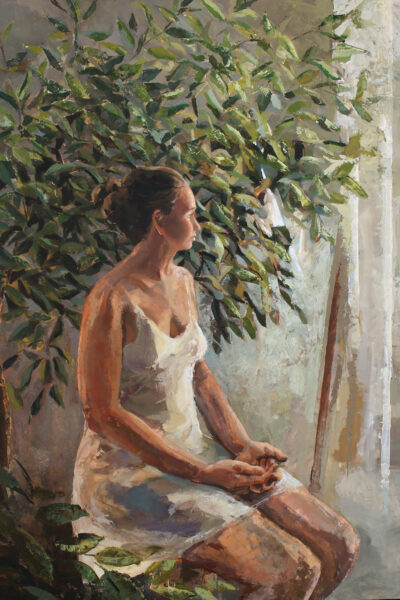
In the Florentine painting at St. Mark’s, painted by Giuseppe Catani Chiti of Prato (b. 1866), a stump, dead and rotting inside, divides the composition down the middle. It is a daring placement, to have an object in the foreground like that, although we do often see a column splitting the space between Mary and the angel in paintings such as this famous Annunciation by Fra Angelico also in Florence, in the monastery San Marco. We can see that it is sprouting flowers at the top, representing the new life that has come with Christ to the dried up tree of Ezekiel and the stump of Jesse in Isaiah.
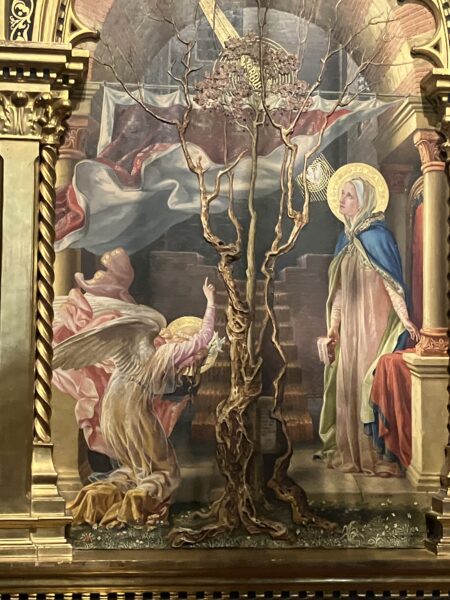
Annunciation painting by Fr. Giuseppe Chiti di Prato (b. 1866) in St. Mark’s Anglican Church, Florence, Italy
Mary and Jacob’s Ladder
The symbol in the Giuseppe Catani Chiti painting that most captured my attention, however, was the staircase behind the curtain. It’s central placement in the painting underneath an arch echoed seemed to echo my painting “Ascent/Descent”. The stairs in my painting reference Jacob’s Ladder, often seen in Byzantine tradition as a prefiguration, or prophecy, of the Virgin Mary. However, I have rarely seen Mary represented with a ladder or stairs outside of Byzantine iconography, so this painting by Fr. Giuseppe Chiti di Prato stood out to me when I saw it at St. Mark’s.
I encountered the association of Jacob’s Ladder with the Virgin Mary while researching this icon from St. Catherine Monastery on Mt. Sinai. The icon and the way its visual structure and contents connected the Old Testament and the New Testament introduced me to an entirely new way of reading Scripture. In that icon one small image representing Jacob’s ladder is included as one of many Hebrew Bible narratives prefiguring Mary and her role in salvation history.
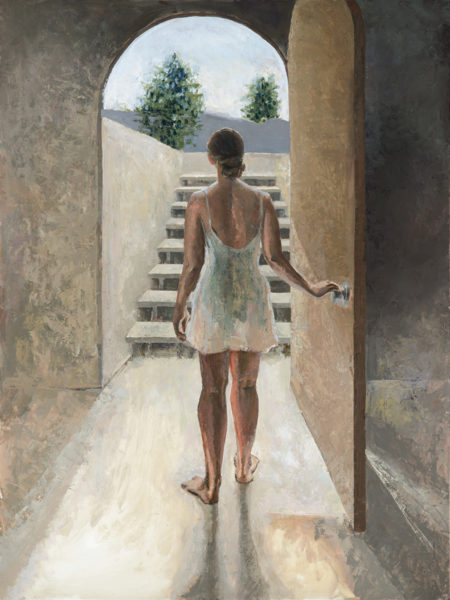
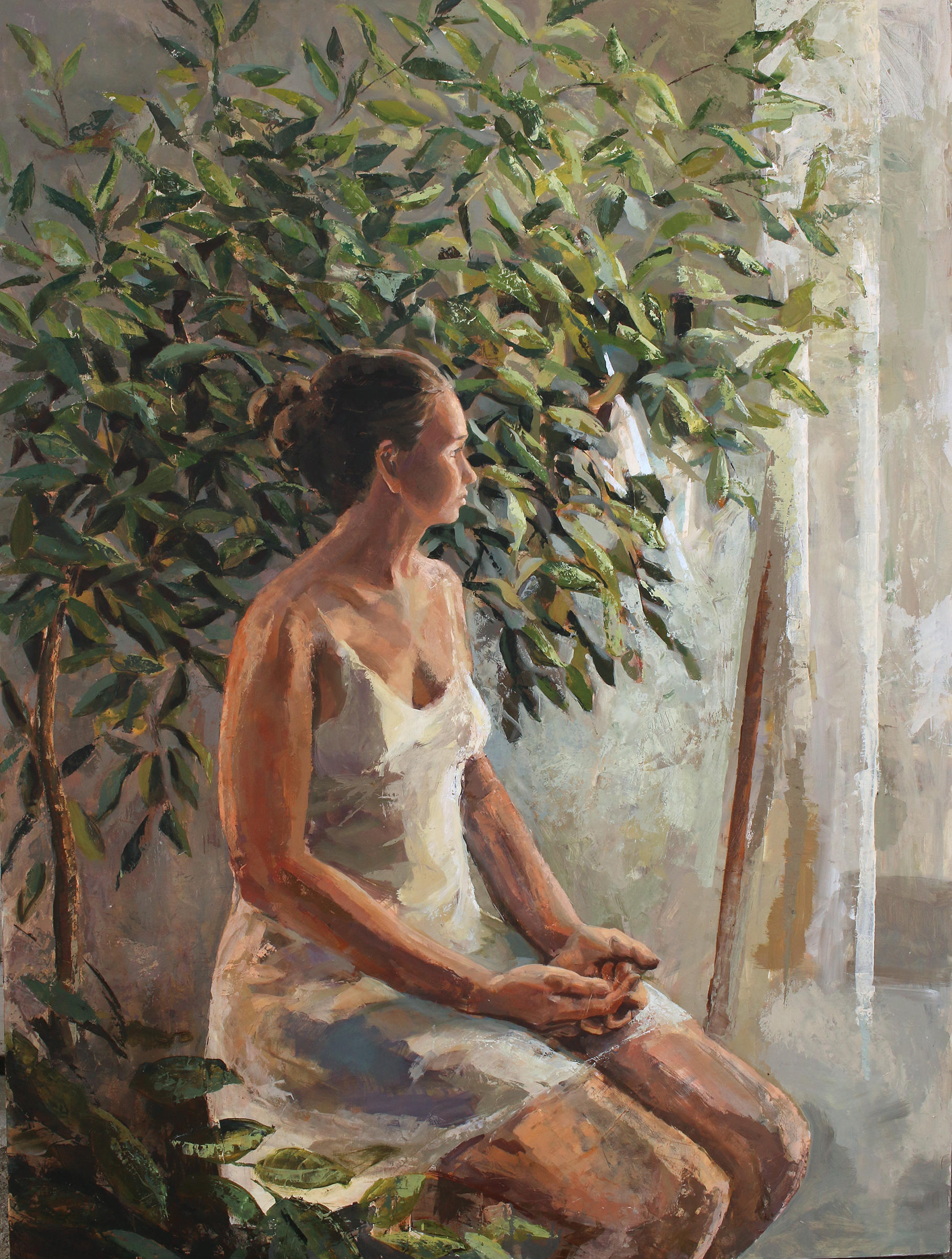
“Ascent/Descent”, Oil on Panel, 48″ x 36″ ©Michelle Arnold Paine Private Collection
The narrative of Jacob’s ladder was the inspiration behind my painting “Ascent/Descent”, now in a private collection. I wrote in depth about the imagery behind it in Mary and Jacob’s ladder in this blog post.
The Annunciation and the Veil of the Temple
The curtain most likely refers to the veil in the Temple which separates the Tabernacle and the Holy of Holies from the rest of the Temple space. It represents the division between God’s perfect divinity and humankind’s imperfection and sinfulness. When Jesus died, the curtain of the Temple was ripped in two (Matthew 27:51, Mark 15:38, Luke 23:45). In Jesus’ complete sacrifice He made it possible for us to experience salvation, to become reunited eternally with God.
In the moment of the Annunciation, Jesus has not yet been born. But in the moment of His conception, the veil that separates the human and the divine begins to flutter. The stairway to eternity which had been hidden by sin becomes visible again. This painting of the Annunciation with stairs hints at what will come, that the means to climb this staircase is on its way.